
AI economics / 6 min read
The Real AI Question for Your Factory: What Does It Cost Per Part?
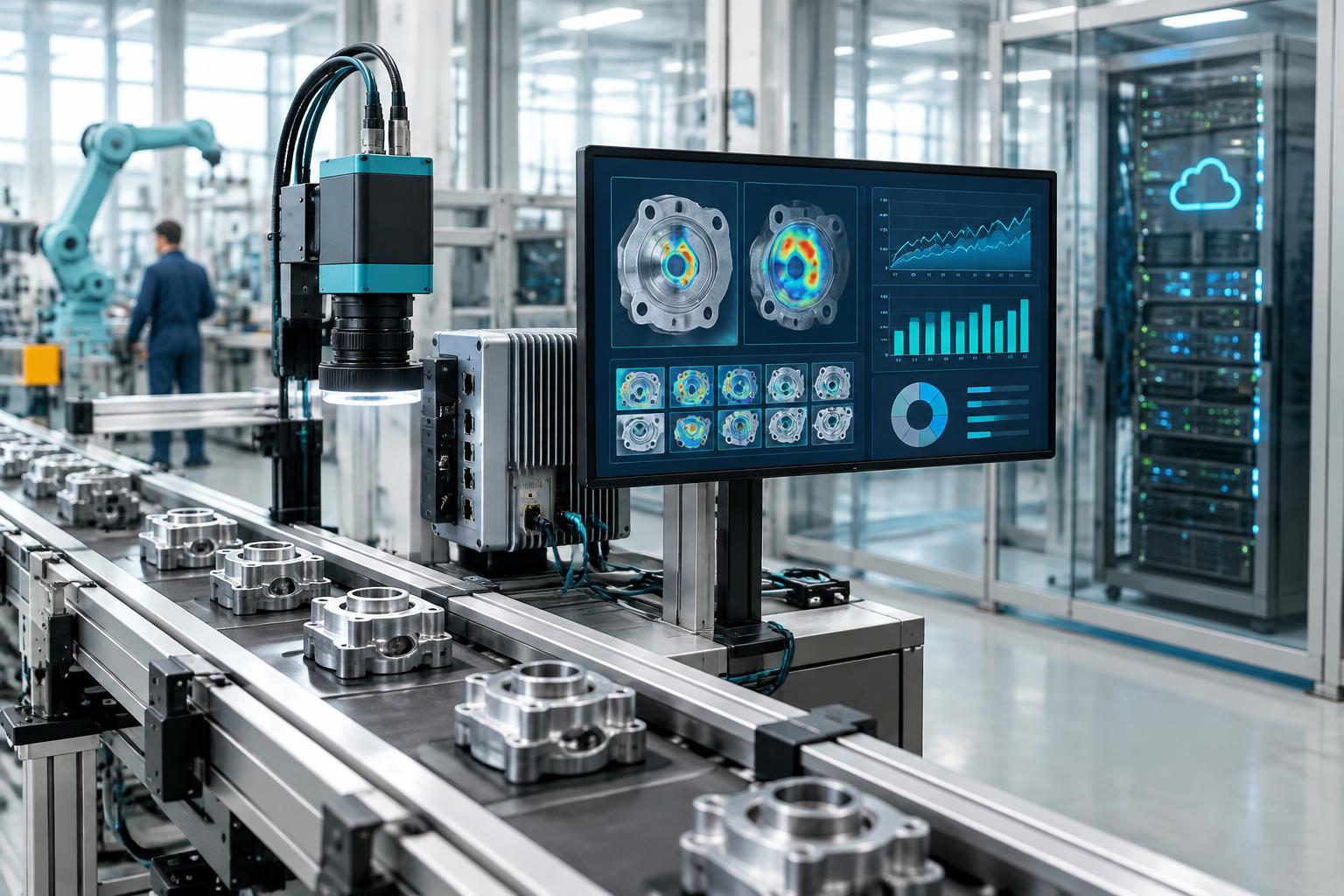
The winning question in manufacturing AI has changed from "how smart is the model?" to "what does it cost us each time it works?" That shift is now a CEO, CFO and COO decision, not an IT one.
The AI bill now arrives every day
For years the money and attention went into building AI. As manufacturers move from pilots to production, the cost of running it becomes a recurring operating decision.
For a manufacturer, this is where AI either earns its place on the plant floor or becomes an expensive science project. An AI program can look very costly before it looks successful. Unless the cost to run it falls, many pilots will never scale.
Inference in plain English
Inference is the AI doing its job after it has been trained. Every answer, every flagged defect, every forecast is one act of inference, and each one has a running cost.
Think of training as writing the textbook. It is slow and expensive, and you do it once. Inference is answering a student each time a hand goes up. The textbook is finished, but the hands keep rising, all day, in every plant.
That is why the economics change. Training is a project budget. Inference is an operating cost that grows with every camera, every line and every shift that depends on AI.
For a language model, two steps happen inside every answer, and they strain the hardware in different ways.
Reading. The AI takes in the question or the data. A long input, like a 300-page contract, means more reading work.
Writing. The AI produces its answer one piece at a time. A long, live response leans on how fast memory can feed the chips.
Because the work differs by job, one type of chip no longer fits every use. Expect a wider mix of specialized hardware.
The new scorecard: cost per useful outcome
Enterprises should judge AI by what a useful result costs, not by how fast a chip is on a spec sheet. A forecasting model and a visual inspection system need very different things, and no single benchmark captures that.
For your plant, the translation is direct. Stop asking "which AI platform is best?" and start asking what each outcome costs to deliver reliably.
Cost per inspected unit. Cost per defect caught before shipping. Cost per unplanned stoppage avoided. Cost per resolved service ticket.
These numbers let a CFO compare an AI program to the process it replaces. They also expose a hard truth early. If the cost to serve each outcome is higher than the value of that outcome, scaling the program only scales the loss.
A second implication matters for buyers. Scarcity of top chips, memory and power can increase prices. Value lies in lowering cost, raising utilization and cutting delay. Your leverage as a customer grows when you can state your needs as outcomes and costs, not as hardware wishes.
Where your AI should run: it is a money question
Many AI workloads can technically run in several places. The real question is who pays, how fast the answer must come back, and who must control the data. For manufacturers, that points to four places.
Cloud. Best for large models, bursty demand and data already centralized. Manufacturing applications include planning, forecasting, supplier analysis and enterprise-wide assistants.
Your data center or private cluster. Best for sensitive data or strict governance. This can suit product designs, formulas and customer data you cannot let out.
Edge, on the plant floor. Best when moving the data costs more than using it. Camera inspection on every unit leaving the line is a clear manufacturing fit.
Device. Best when the model is small and speed or offline use matters. Handheld tools and operator aids can work without a connection.
Consider a plant running visual inspection on every unit coming off the line. If sending all that video to the cloud costs more than processing it on site, the AI belongs at the edge.
One honest caution: who pays at the edge is not always clear. Plant operators, equipment makers and technology vendors may have different incentives. Settle the funding question before you scale.
What it takes to run inference well
Running AI at a good cost takes a full stack working together, and software often wins the early savings.
On the hardware side, four things set the ceiling.
Compute. The chips that do the math.
Memory. Fast storage that feeds the chips. Memory speed, not raw chip power, can limit how fast AI answers.
Networking. The links that connect systems and let work spread across them.
Power and cooling. Heat and electricity can cap how densely you pack equipment, sometimes before compute does.
On the software side, near-term savings may need no new hardware. Reuse work the system has already done, send simple requests to small, cheaper models and save the big models for hard ones, and schedule jobs more effectively. These gains can stack on top of each other.
The last layer is yours: your own data and your own workflows. Hardware sets what a system can deliver. Software, plus how well AI is wired into your plant data and processes, decides what it actually delivers.
One more point for planning. Chips take years to design, while AI models change in months. Avoid locking into a single narrow setup. Open standards keep your options open, because specialized systems only pay off when they can be reused widely.
Five questions to ask your team this quarter
1. What does one useful outcome cost us today? Name the unit, such as per part inspected or per stoppage avoided, and put a number on it.
2. Where does each workload need to run? Sort them by cost, speed and data control before you buy anything.
3. Who pays for AI at the edge? Settle plant, vendor and equipment maker roles before you scale a pilot.
4. Are we cutting cost in software first? Ask whether cheaper models, reuse and scheduling have been tried before new hardware is approved.
5. How locked in are we? Favor open models and standards so a change in the market does not strand your investment.
The bottom line
The factories that win with AI will not be the ones with the fanciest models. They will be the ones whose AI pays for itself on every part, every shift and every line.
The task is to serve intelligence economically at scale. Manufacturers have a natural edge, because their value is already measured in units, yield and uptime. Bring that discipline to AI, and make cost per useful outcome the number your leadership team watches.